
AI and Technology in Government
12.4.23

This was an event about Tech and AI in the government hosted by Project 47. The event started with a fireside chat with two former Chief Technology Officers of the United States under Obama and Trump: Jennifer Pahlka (founder of Code for America) and Michael Kratsios (Managing Director at Scale AI and board member at Foundation for American Innovation). It was moderated by Marshall Kosloff, who is the host of The Realignment. Afterwards, there was a networking session with some food and drinks. The event was filled with folks from SF interested in Tech, AI, and Government.
Much of the discussion was about moving from tech to government and back again and what people involved in tech and AI can do for our government.
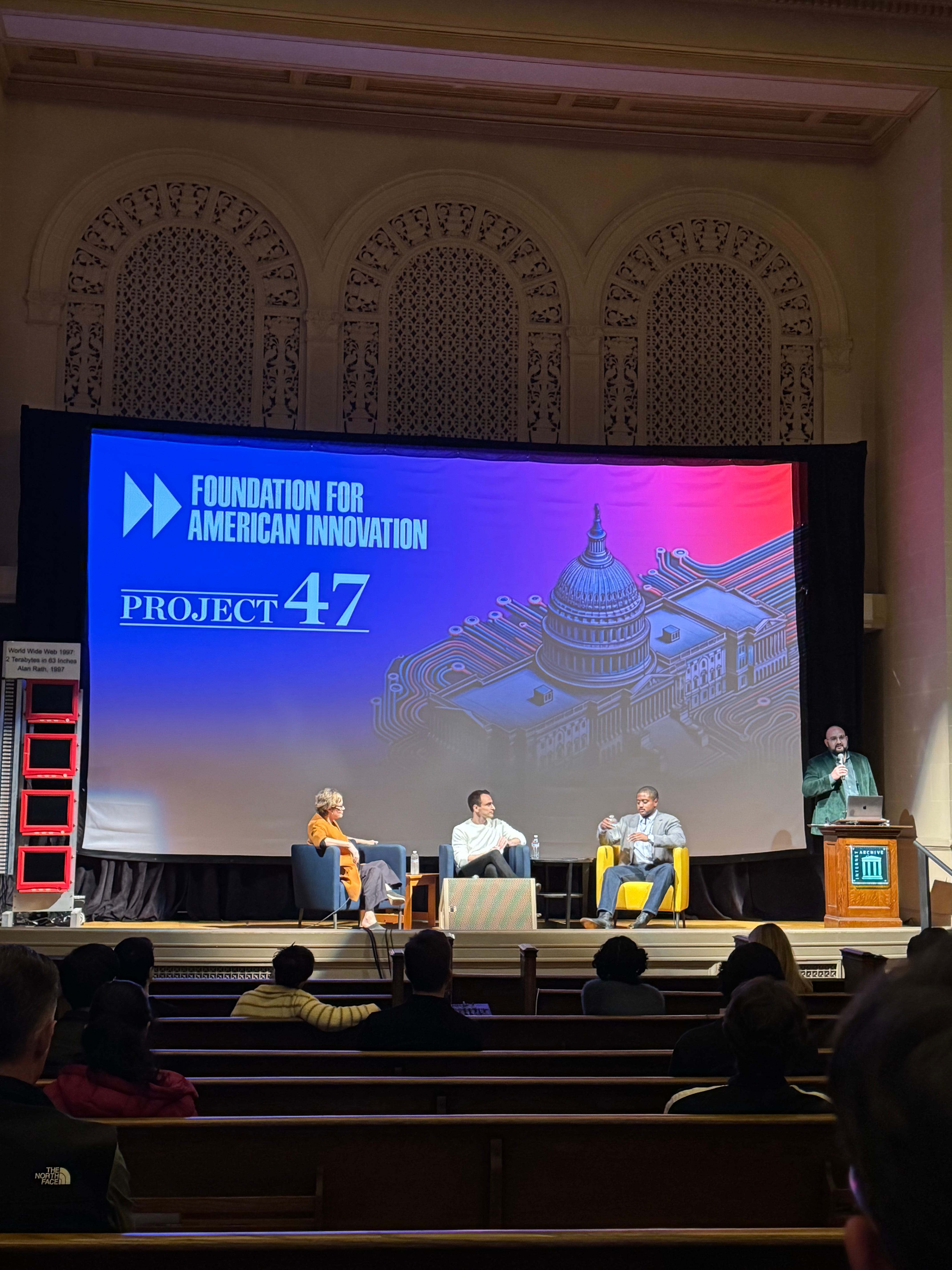
Fireside Chat
SPEAKERS
Jennifer Pahlka // former Deputy Chief Technology Officer of the United States; founder of Code for America; author of Recoding America
Michael Kratsios // former Chief Technology Officer of the United States; Managing Director, Scale AI; board member, Foundation for American Innovation; Previously a principal at Thiel Capital
Marshall Kosloff (Moderator) // Host of The Realignment; Media Fellow, Foundation for American Innovation
Q&A
Marshall: What was the essential technological problem facing the USA when you were CTO?
Jennifer: In 2012, service delivery was the one problem she wanted to work on. She knew what public sector technologies looked like and wanted to redo all the old websites to improve the government’s ability to deliver services to the American public.
Michael: When Obama created the role, he’d argue the biggest challenge was that agencies were built on archaic tech stacks and we needed to have websites that work, have websites on the cloud, do services online instead of in person or on the phone. By 2017, 8 years had already been spent on federal tech work and there was a long history of how to get that accomplished. Therefore, he took on a different challenge and focused on national policy, which was the central problem in his opinion. At that point, they started talking about AI, for example to make sure that the CCP doesn’t catch up. His time there was spent on how to influence leaders to make strides in leading emerging tech.
—
Marshall: How much of the job (technologists in government) is fixing things versus understanding bureaucracy?
Jennifer: In the CTO role, you have to do both. Generally, authority can be pretty diffuse in government. For example, if you’re trying to solve a very horizontal problem, then there tends to be a lot of people who are already supposed to be solving that problem, so there is a lot of navigation that needs to be done. But increasingly, the US government is becoming better at just “solving the problem outright.” It may sound bad, but this happens in big companies too, so it’s not unique to governments. However, companies can fail, but it’ll be really bad if the US government fails.
Michael: the biggest successes were when there were brilliant technologists paired with wonky authoritative people who are good with bureaucracy hacking.
—
Marshall: White House priorities drive everything. During Obama’s time, we had a very optimistic view of tech, and therefore he wanted to just take everything from SF and implement it in DC. Then over time our attitudes towards tech changed. What do you think is the White House’s priority today?
Michael: It’s whatever it takes for America to win. Adversaries are pressing ahead at high speed. In core things like quantum information science, bio tech, and AI, the CCP has made it clear that they will use this tech for authoritarian agendas. They can and will use it to convince people who are on the fence between siding with the US or with them. We also need to be able to deliver on our policies from a technological level. For example, during Covid, at SBA they were trying to give out PPP loans online. Regardless of whether the policy was good or bad, it was very clear that it was difficult for the government to implement it properly. One proxy to look at how bad we are at is is the sheer number of PPP frauds.
Jennifer: Right now, there is a big gap between intention of laws that are passed and the outcomes which ultimately erodes faith in democracies. I think people feel in their bones that what the government says is not actually what happens. For example, when they say to give people “pandemic relief” but then people don’t actually feel like they got it. After Covid, it’s pretty clear that the CDC needs the best and brightest people to make it better.
—
Marshall: Let’s say we need to win in AI and need smart technologists in government. How do we do it?
Michael: Talked about two strategies when it comes to national strategies. First, there are federally funded R&D initiatives. Currently it’s $165bn. We need to make sure it is allocated into the right programs. Second is technological regulation. We need to create a regulatory environment where startups can thrive. Get the right people together to figure this out (lawyers and technologists)
Jennifer: We need to answer core questions such as “should government develop its own AI?” It’s also obvious that AI is going to be used everywhere, but the government should also be using it so it does not get left behind. There’s going to be a lot of caution (which is good), but someone also needs to make sure the government does not get left behind by saying “yes there are all these downsides, but there are also these pros to using AI.”
—
Marshall: How did your experience prepare you for CTO?
Michael: In 2010s, I noticed a trend that many of the companies (SpaceX, Stripe, Uber, and Lyft)that were succeeding and growing were in more and more highly regulated industries. Venture was clearly trying to attack heavily regulated industries as places of opportunity. One observation was that during the diligence process, there was always more and more diligence done on regulatory risks, which was very sad becuase it felt like it was halting innovative companies. When he finally became CTO, he tried to remove regulatory things that would hurt innovation.
Jennifer: When she founded Codeforamerica in 2010, she figured out how hard it was to get stuff done at the local level. But she also realized that if they just had the people ready to do the hard work, things can actually get done. So she wanted to run this playbook again when she became CTO. She saw that having technologists and policy people work with each other was a recipe for success.
—
Marshall: How does technology play a role in national security?
Michael: In the last few years, there’s been a renaissance in defense tech (Anduril and Palantir), which is good, but we can do so much better. For example, there’s not that many AI programs at the DoD because there just isn’t a deep deep bench of ML engineers in the government. It’s a deep and structural problem. He likes to use the dull knife analogy - “in what world do we want to equip our military and people who protect us with a dull knife or suboptimal weapons? In what world do we want our technologies to be suboptimal?”
Jennifer: If you’re on the ground in the DOD trying to get something done, it’s terrifying. One example she saw was the Air Force wantted to get new software for satellite to run GPS. They’ were already over budget and years late and just couldn’t get to a solution. At the end of the day, the real reason why it couldn’t be fixed was because there was this “required” architecture in a DoD contract and the only reason why it was in the contract was that there was no one technical enough at the DoD to say that this was not actually required.
—
Marshall: What are the most important areas?
AI, quantum initiative, cryptography, threat posed by bio security and climate implementation. Can go on Tech.gov. ai.gov, and https://www.govinfo.gov/collection/plum-book to look at roles.
Know someone who would benefit from getting notes from AI events in SF?
Have feedback on how I can improve or have additional notes from the event to add?
Thanks for reading AI Notes! Subscribe for free to receive new posts and support my work.